

Dash cams have become increasingly common on UK roads, from city commuters navigating busy roundabouts to long-distance drivers covering motorways every day. If you've ever wondered How Do Dash Cams Work, what they actually record, or whether they are worth fitting in your vehicle, this guide breaks everything down clearly.
We'll cover what dash cams do, how they record footage, where videos are stored, typical costs in the UK, and how to choose the right model for your driving needs.
Table of contents
What Is A Dash Cam? What Are Dash Cams Used For? How Does A Dash Cam Work How Does Dash Cams Record Videos? Does Dash Cam Work When Car is Off? Where Is Dash Cam Footage Stored? How Long Does a Dash Cam Record For? How Much Does a Dash Cam Cost in the UK? How to Choose the Right Dash Cam? Are Dash Cams Legal? FAQs
What Is A Dash Cam?
A dash cam (short for dashboard camera) is a compact in-car camera that is usually mounted on the windscreen or dashboard. Its main purpose is to continuously record video while you drive, capturing the road ahead and, in some models, the interior or rear of the vehicle.
Dash cams are typically powered through the vehicle's 12V socket or a hardwiring kit connected to the car's electrical system. In the event of an accident or dispute, dash cam footage can act as an independent visual record of what actually happened.
What Are Dash Cams Used For?
Dash cams serve a wide range of practical purposes beyond simple video recording. Below are the most common reasons drivers choose to install one.
Accident Evidence and Incident Recording
Dash cams provide clear, time-stamped footage of collisions or near misses. This evidence can help clarify what actually happened, especially in situations where accounts differ or fault is disputed.
Supporting Insurance Claims
Having dash cam footage can speed up insurance claims by confirming details such as road position, traffic signals, or sudden braking. Many UK insurers recognise dash cam footage as supporting evidence during claims investigations.
Preventing Insurance Fraud
Staged accidents and false claims do happen. Dash cams help protect drivers by recording events exactly as they unfold, making it much harder for fraudulent claims to succeed.
Recording Dangerous or Aggressive Driving
If you encounter reckless driving, tailgating, or road rage incidents, dash cam footage provides factual evidence. In serious cases, it may be shared with the police to support reports of dangerous driving.
Vehicle Protection While Parked
Some dash cams include parking mode, which allows recording even when the engine is off. This is particularly useful for capturing hit-and-run damage, vandalism, or attempted theft while your car is parked.
Capturing Scenic Routes and Journeys
Many drivers also use dash cams to record scenic countryside drives, coastal roads, or memorable road trips. The footage can later be saved or shared as personal travel memories.
How Does A Dash Cam Work
A dash cam automatically starts recording when your car's engine is on, capturing the road ahead in short video clips that are saved on a microSD card. This ensures that important moments are stored safely and can be reviewed when needed. The memory card manages the files automatically, often overwriting older footage once it's full.
When the car is parked, some dash cams continue recording using parking mode, which monitors for movement or impacts. This typically requires a direct connection to the car's electrical system or an external power source. By handling both recording and storage efficiently, dash cams provide continuous protection without constant user intervention.
How Does Dash Cams Record Videos?
Dash cams record video using different modes, depending on the situation.
Incident Recording
Using built-in G-sensors, dash cams detect sudden impacts or sharp movements. When triggered, the camera automatically saves and locks the relevant video clip to prevent it from being overwritten.
Continuous Loop Recording
This is the default mode for most dash cams. The camera records continuously while driving, overwriting older files when the memory card becomes full. Important clips can be manually locked to keep them safe.
Parking Mode Recording
In parking mode, the dash cam monitors your vehicle while it is stationary. Recording may be triggered by motion, vibration, or operate in time-lapse mode to conserve power and storage.
Recommended:
Does Dash Cam Work When Car is Off?
Not all dash cams record when the car is switched off. Standard models powered through the 12V socket stop recording once power is cut.
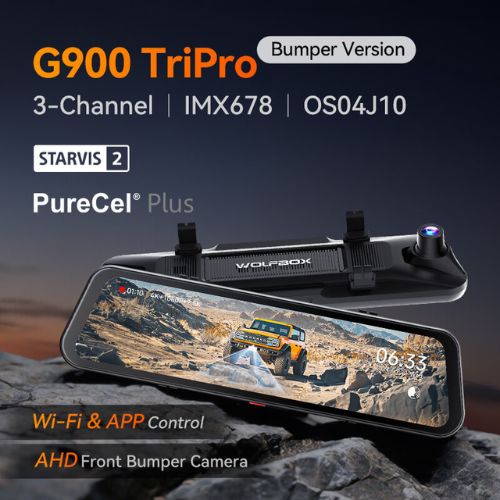
Dash cams with parking mode, such as the Wolfbox G900Pro and G900 TriPro, can continue recording when the vehicle is parked. These models rely on hardwiring kits or dedicated battery packs to draw power safely without draining the car battery.

Where Is Dash Cam Footage Stored?
Most dash cams store footage on microSD cards, typically supporting capacities from 16GB up to 256GB or more, depending on the model.
Once the card reaches capacity, older footage is automatically overwritten unless files are locked. Some dash cams allow manual protection of important clips to ensure they are not deleted.
More advanced models may also offer cloud storage, enabling footage to be uploaded remotely. Wi-Fi or Bluetooth connectivity allows drivers to view and download videos directly to a smartphone without removing the card.
How Long Does a Dash Cam Record For?
Recording time depends on video resolution, compression, and memory card size.
How Long Can a 128GB SD Card Record in Dash Cams?
A 128GB SD card can store videos starting from 12 to 18 hours of 1080p resolution. If you are using 4k resolution, the storage time will be limited to 4 to 6 hours.
How Long Can a 256GB SD Card Record in Dash Cams?
A 256GB SD Card can store videos from 24 to 36 hours of 1080p resolution. It can keep the recording of 4k resolution from 8 to 12 hours, before it overwrites it. This card can be used for high-definition videos or dual camera setups.
How Long Can a 512GB SD Card Record in Dash Cams?
A 512GB SD Card can store videos for up to 48 to 72 hours of 1080p video. It can keep 4k video for about 16 to 24 hours. These cards can be used to store videos for longer time for long-distance traveling without fear of overwriting. You can find the SD Card best for Wolfbox G900 Pro or G900 TriPro from here: Wolfbox 512GB SD Card.
How Much Does a Dash Cam Cost in the UK?
Dash cam prices vary depending on resolution, features, and build quality.
Entry-Level Dash Cams
Basic models offering 1080p video and loop recording usually cost between £40 and £120. These are suitable for drivers who want simple, reliable road recording without extra features.
Mid-Range Dash Cams
Dash cams with GPS, Wi-Fi, and higher resolutions such as 1440p or entry-level 4K generally fall between £120 and £250. These models provide clearer footage and added convenience for reviewing videos on a smartphone.
Premium Dash Cams
High-end dash cams with advanced night vision, parking mode, dual-channel (front and rear) recording, and enhanced sensors can cost £250 to £400+. These are ideal for drivers seeking maximum protection and round-the-clock monitoring.
A great example is the Wolfbox G900 TriPro, available in two versions: the Bumper version, which records the front bumper, front, and rear views, and the Cabin version, which captures the front, interior, and rear. Both versions provide 4K clear night‑vision recording and 24/7 parking monitoring for complete coverage.
How to Choose the Right Dash Cam?
Selecting the right dash cam depends on your driving habits and priorities.
1. Video Quality
Always go for the cameras that can record clear videos. Choose the camera with the minimum resolution of 1080p to get good clarity for most driving scenarios. You can use 1440p or 4k resolution for better details like license plates or road signs.
2. Field of View
Choose the dash cams tat have a wider field of view (FOV) to capture more surroundings. The camera of FOV between 140° and 170° can cover both lanes of traffic and road ahead.
3. Storage Capacity
Dash cams that support higher capacities can be used to keep the recording for larger time. Therefore, choose the camera between 128GB to 512GB depending on the resolution you want to use.
4. Advanced Features
Parking Mode: This feature lets the dash cams record even when your vehicle is turned off.
GPS Tracking: With this feature, you can track your speed and location which can be used as evidence in case of an incident.
Wi-Fi: You can transfer videos easily to your phone or cloud storage with Wi-Fi compatible cameras.
Night Vision: It is useful for night driving as it provides better video quality in low-light conditions.
Recomended: Best Dash Cams with Night Vision

Are Dash Cams Legal?
Dash cams are legal to use in the UK, but drivers must follow privacy and data protection rules.
- The camera should not obstruct the driver's view of the road
- Footage should be used responsibly and not shared publicly without consent
- Audio recording may be restricted under privacy laws
For information on the relevant legal requirements, please refer to official government guidance and legislation.
FAQs
1. Do dash cams record when the car is off?
Yes, dash cams with parking mode can record even when the car is off.
2. How long does a dash cam record for?
The recording time depends on the SD card size and video resolution. It can be from 12 to 72 hours.
3. Can I use a dash cam while driving in any country?
Dash cams are legal in most countries, but audio recording or footage sharing may not be allowed.
4. Can dash cams help with insurance claims?
Yes, dash cam footage can be used as evidence in insurance claims.

